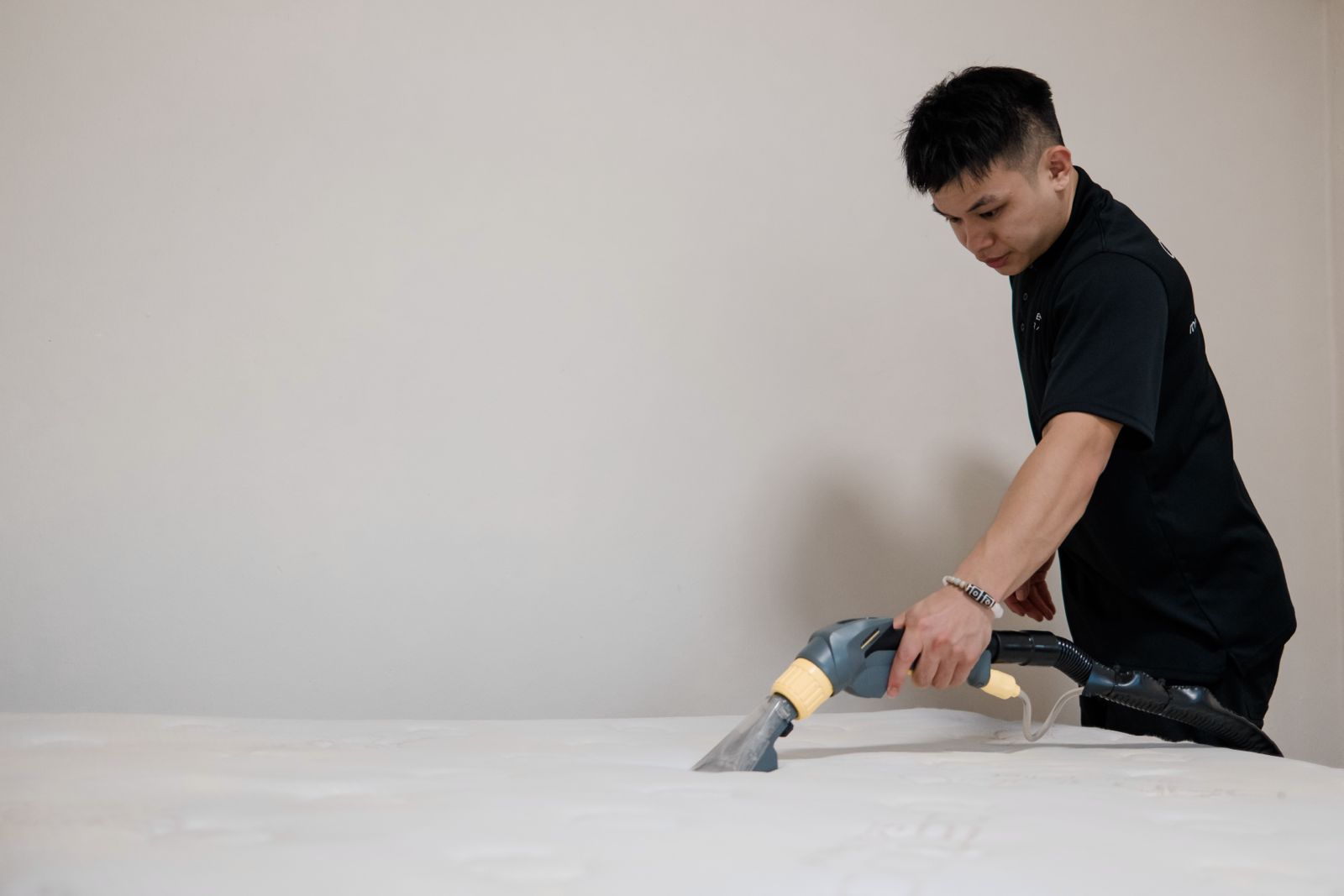
UV-C mattress cleaning is effective at treating bacteria, mould, and viruses on the surfaces the light reaches — but on its own it does not remove dust mites, dead skin, or allergens, and it cannot penetrate deep into the mattress. It works best paired with vacuum extraction, which physically removes the debris while the UV-C sanitises. Used that way, it is genuinely useful. Marketed as a standalone cure-all, it is oversold.
- UV-C is a germicidal wavelength that damages bacteria, mould, and viruses it directly reaches.
- It does not physically remove dust mites, allergens, or dead skin — that needs extraction.
- UV-C only treats surfaces in its direct line of light; it does not penetrate deep foam.
- The effective approach is UV-C combined with dry vacuum extraction, not UV-C alone.
- Be sceptical of any claim that a quick UV pass "kills 99.9%" of everything in a mattress.
What is UV-C, and why is it used for cleaning?
UV-C is a short-wavelength band of ultraviolet light. At the right intensity and exposure, it damages the genetic material of micro-organisms, which stops bacteria and viruses from functioning and reproducing. It is the same germicidal principle used to treat water and disinfect equipment in some clinical settings. So the underlying science is real — UV-C does inactivate germs it reaches directly.
That is why it has a place in mattress sanitisation. A mattress harbours bacteria and can develop mould in humid conditions, and UV-C is a chemical-free way to treat those on contact. The question is not whether UV-C works, but what job it is actually doing.
What UV-C genuinely does well
Used correctly, UV-C treats micro-organisms on the surface it illuminates, without any chemicals and without adding moisture. For a mattress that is a real advantage: it means the sanitising step leaves nothing behind against your skin and needs no drying time. For homes with children, or anyone sensitive to cleaning chemicals, a chemical-free germicidal step is a meaningful benefit.
So the honest positive is this: as a sanitising element, UV-C addresses bacteria, mould, and viruses cleanly and safely.
What UV-C does not do
Here is where a lot of marketing overreaches. UV-C has three real limits, and understanding them is the difference between a sensible expectation and a disappointed one.
It does not remove dust mites or allergens
This is the big one. The main trigger for mattress allergies is not live germs — it is the allergen proteins in dust mite droppings and shed skin. UV-C might affect a mite it directly hits, but it does not remove the mites or the allergen debris from the mattress. Those have to be physically extracted. A UV light passed over a mattress leaves the allergens exactly where they were.
It only reaches the surface
Light travels in a straight line and does not pass through solid material. UV-C treats what it directly illuminates on the surface. It does not penetrate into the foam and padding where a great deal of the build-up sits. Any claim that a handheld UV device sanitises the "deep layers" of a mattress is not how light works.
Exposure and intensity matter
UV-C needs sufficient intensity and enough dwell time to be effective. A quick wave-over from a low-power gadget does far less than a proper, integrated system used at the right pace. This is why cheap consumer UV wands rarely live up to their packaging.
Why "kills 99.9% of germs" deserves scepticism
Numbers like "99.9%" usually come from controlled lab tests on a specific organism, at a specific distance, for a specific exposure time, on a flat surface. A real mattress is none of those things — it is soft, uneven, and full of shadowed crevices the light never reaches. The lab figure is not a lie, but it is not what happens on your bed either. Treat any blanket percentage claim about a whole mattress with caution.
The effective approach: UV-C plus extraction
UV-C is a good component and a poor complete solution. The reason our mattress sanitisation pairs it with dry vacuum extraction is that the two steps cover each other's gaps. The extraction physically pulls dust mites, allergens, and dead skin out of the mattress layers — the part UV-C cannot do — while the integrated UV-C germicidal light treats bacteria, mould, and viruses as the surface is worked. Neither step alone is enough; together they address both the debris and the germs.
Because it is a dry method, there are no chemicals and no drying time. Where a mattress also has staining or set-in odour, we add wet extraction — a pre-treatment spray and high-pressure extraction — since UV-C does nothing for stains. Matching the method to the actual problem is the point; UV-C is one honest tool in that kit, not the whole kit.
The same logic applies to fabric furniture, so our upholstery cleaning combines extraction and sanitising in the same way.
How to read UV mattress-cleaning claims
Once you know what UV-C can and cannot do, the marketing sorts itself out quickly. A few things to watch for when you compare services:
- Is UV-C the whole service, or one step? If a company sells "UV mattress cleaning" and nothing about extraction, ask how the dust mites and allergens are actually removed. If the answer is only "the UV kills them," that is a red flag.
- Blanket percentage claims. A flat "kills 99.9%" applied to an entire mattress ignores the shadowed crevices light never reaches. Sensible providers describe what the method does, not a single hero number.
- Handheld gadget or integrated system. A quick pass with a low-power wand is not the same as UV-C used at proper intensity and dwell time as part of a professional process.
- What happens to stains and odours. UV-C does nothing here. A complete service will have a separate step for them.
None of this means UV-C is a gimmick. It means UV-C is one part of a good service, and a service built on UV-C alone is leaving the biggest job — removing the debris — undone.
Frequently asked questions
Does UV-C light kill dust mites?
UV-C may affect a mite it directly hits, but it does not remove dust mites or their allergen droppings from the mattress. Physical extraction is what actually clears them, which is why UV-C is paired with vacuum extraction rather than used alone.
Are UV mattress-cleaning wands worth buying?
Consumer UV wands are limited by low intensity, brief exposure, and surface-only reach, so they do far less than the marketing suggests — and they do nothing for allergens or stains. For a genuine result, a professional service that combines UV-C with extraction is the better route.
Is UV-C safe to use on a mattress at home?
UV-C light can harm skin and eyes on direct exposure, so it needs to be handled properly. In a professional service it is used as an integrated, contained part of the equipment. That safety consideration is another reason it is better delivered by a trained operator than a household gadget.
Is UV-C better than steam cleaning for a mattress?
They do different jobs. UV-C treats germs on the surface without moisture; steam or wet extraction lifts stains and odours but adds water that must be managed in a humid climate. The best result usually comes from combining a dry UV-C sanitising step with extraction, matched to what the mattress needs.
Want the honest version, not the hype?
UV-C is genuinely useful when it is paired with extraction and used properly — and oversold when it is not. If you want a mattress sanitised the effective way, message us on WhatsApp for a mattress sanitisation quote, or contact us and we will explain exactly what our method will and will not do for your mattress.