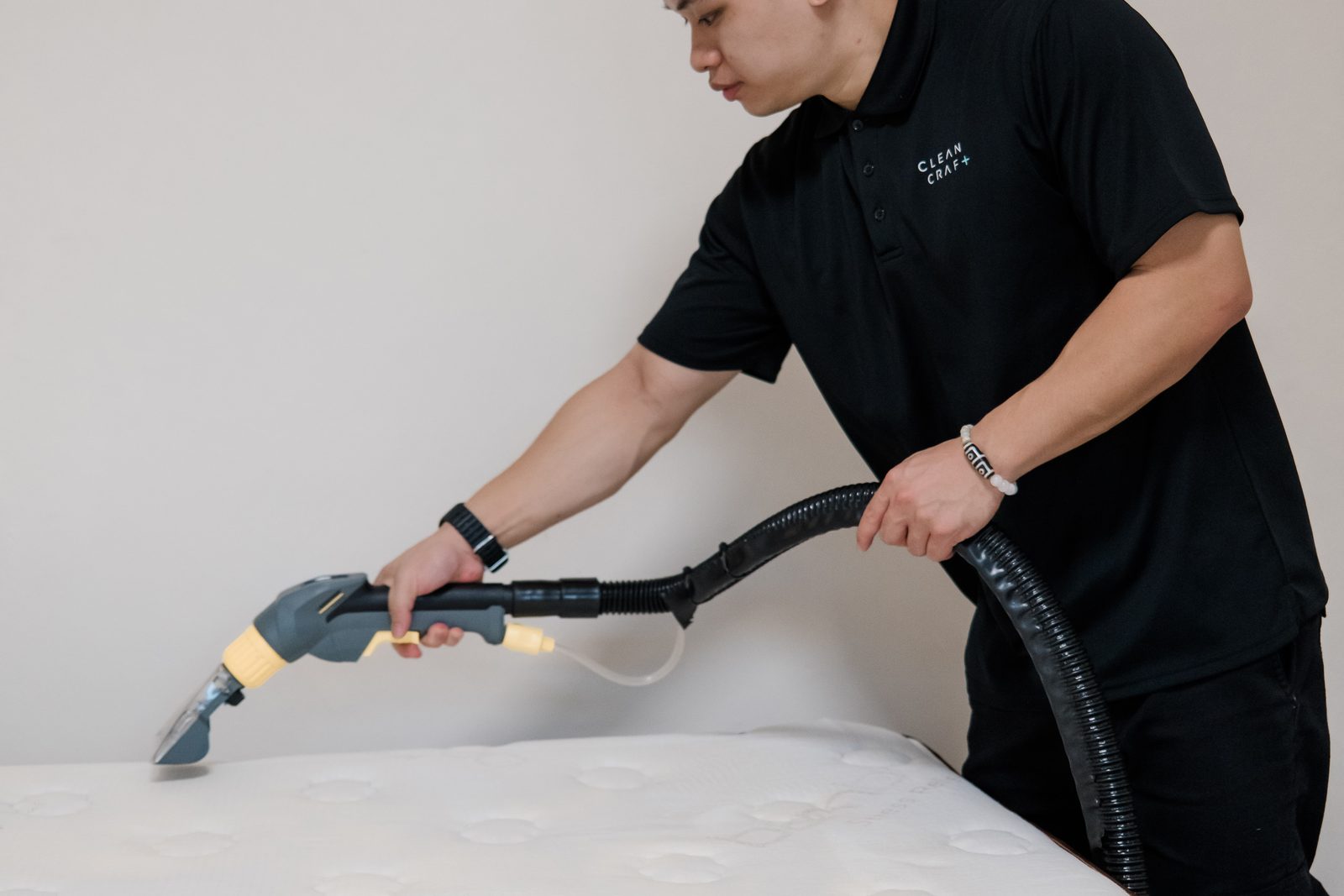
To clean a mattress at home, strip the bedding, vacuum the whole surface, spot-treat stains with a mild solution, deodorise with baking soda, then let it air out. This handles surface dust and light marks. What it cannot reach are the dust mites, allergens, and moisture deep inside the layers — and for that you need professional sanitisation.
- Home cleaning removes surface dust, light stains, and odour — it does not remove embedded dust mites or deep allergens.
- Vacuum with the upholstery attachment, spot-treat with a mild solution, and never soak the mattress.
- Baking soda deodorises; sunlight and airflow help, but Singapore's humidity limits how much they do.
- If someone in the home has allergies, asthma, or the mattress is more than a couple of years old, professional sanitisation reaches what a home vacuum cannot.
- Cleancraft uses dry vacuum extraction with UV-C sterilisation — no chemicals, no drying time.
Why bother cleaning your mattress at all?
You spend roughly a third of your life on your mattress. Over months it collects dead skin, sweat, dust, and the dust mites that feed on all of it. In Singapore's humidity, that build-up happens faster than in drier climates, and it sits in a layer you cannot see.
Regular home cleaning keeps the surface presentable and slows the build-up. It is worth doing. But it is honest to say upfront where its limits are, so you know when a vacuum and some baking soda are enough and when they are not.
What you need before you start
Nothing exotic. Most of this is already in the home:
- A vacuum cleaner with an upholstery or crevice attachment
- Baking soda
- A mild dishwashing liquid or gentle enzyme cleaner
- Two clean cloths and a spray bottle of cool water
- A dry towel
Avoid bleach and harsh solvents. They can discolour the fabric, leave residue against your skin, and do little for the problem that actually matters, which is what lives beneath the surface.
How to clean your mattress, step by step
1. Strip and wash the bedding
Remove sheets, mattress protector, and pillowcases, and wash them in the hottest water the labels allow. Hot washing is one of the few home steps that genuinely reduces dust mites in fabric, so do not skip it.
2. Vacuum the entire surface
Fit the upholstery attachment and go over the top slowly, then the sides and seams. The seams and quilted grooves are where dust and mite debris gather, so give them extra passes. If the mattress is not too heavy, flip it and vacuum the underside too.
3. Spot-treat stains
Mix a little mild dishwashing liquid into cool water. Dampen a cloth — do not soak it — and blot the stain from the outside inward. Blot, do not scrub. For older organic stains such as sweat or urine, a gentle enzyme cleaner works better than soap. The key rule is restraint with moisture: a mattress that gets too wet cannot dry properly in a humid flat, and trapped damp invites mould.
4. Deodorise with baking soda
Sift a thin, even layer of baking soda across the whole surface and leave it for a few hours, longer if you can. It absorbs moisture and neutralises odour. Then vacuum it all off. If the room smells stale rather than of any one thing, this step usually helps.
5. Air it out
Open the windows, turn on a fan, and let air move across the mattress before you make the bed. A few hours of direct sun on the fabric helps as well. In Singapore, though, ambient humidity means airflow only does so much — it is a finishing step, not a deep clean.
What home cleaning cannot do
Here is the part most guides leave out. A household vacuum lifts loose surface debris. It does not pull embedded dust mite allergens, bacteria, or moisture out of the deeper foam and padding, because that material is sealed inside the mattress and a normal vacuum has neither the extraction force nor a way to sanitise what it disturbs.
So if you vacuum regularly and still wake with a blocked nose, itchy eyes, or sneezing, the trigger is usually sitting below the level your home tools reach. That is the line between cleaning and sanitisation.
Common mattress-cleaning mistakes to avoid
A few habits do more harm than good, and they come up again and again:
- Soaking the mattress. Drenching a stain or over-wetting the surface pushes moisture into the foam, where it cannot dry in humid conditions and can turn to mould. Damp, not wet, is the rule.
- Using bleach or strong solvents. They can bleach and weaken the fabric, leave residue against your skin, and still miss the deeper problem.
- Scrubbing stains hard. Scrubbing spreads the stain and frays the fabric. Blot from the outside in instead.
- Making the bed while it is still damp. Sealing a slightly wet mattress under sheets traps moisture. Let it dry fully first.
- Relying on air freshener. Spraying scent over a musty mattress masks the smell for an hour and adds nothing underneath. Deodorise with baking soda and address the cause.
Most of these come from trying to force a deep result with surface tools. When the mattress needs more than a careful home clean, the honest move is to bring in extraction rather than push household methods past their limit.
When is it worth calling a professional?
Book a professional mattress sanitisation when:
- Someone in the home has allergies, asthma, eczema, or sensitive skin
- There are babies, young children, or pets sharing or near the bed
- The mattress has never been professionally cleaned and is more than a couple of years old
- There are set-in stains or lingering odours that home methods have not shifted
- You simply want the mattress properly sanitised rather than surface-tidied
How professional mattress sanitisation is different
Our mattress sanitisation service uses dry vacuum extraction combined with UV-C germicidal light. The extraction pulls out dust mites, dead skin, and allergen debris the household vacuum leaves behind, while the UV-C treats bacteria, mould, and viruses on contact. Because it is a dry method, there are no chemicals and no drying time — you can use the bed the same day.
For stubborn stains or odours that need more than a dry pass, we use wet extraction: a pre-treatment spray followed by high-pressure extraction to lift what is set into the fabric. The method is matched to the mattress and the problem, not applied one-size-fits-all. All the solutions we use are non-toxic and safe around children and pets.
If your sofa or headboard could use the same treatment, our upholstery cleaning works on the same principle for fabric furniture.
Frequently asked questions
Can I clean a mattress with a steam cleaner at home?
You can, but be careful. Steam adds a lot of moisture, and a mattress that does not dry fully in humid conditions is at risk of mould. If you use one, keep it brief and dry the surface thoroughly with a fan afterwards. Professional extraction is a safer route because it removes the moisture it introduces.
Does baking soda really clean a mattress?
Baking soda deodorises and absorbs some moisture, which is useful. It does not sanitise or remove dust mites — it just helps the mattress smell fresher. Treat it as part of routine upkeep, not a deep clean.
How long does professional mattress cleaning take to dry?
With dry vacuum and UV-C extraction there is effectively no drying time, so the bed is ready the same day. If wet extraction is needed for stains, we manage the moisture during the process so drying is quick.
Is it safe to clean a baby's mattress?
Yes. We use non-toxic, allergen-safe solutions and can sanitise cot mattresses from baby cot size upward. For young children, the dry UV-C method is a good fit because it uses no chemicals at all.
Keep the surface, book the deep clean
Home cleaning is worth doing between deep cleans — vacuum, spot-treat, deodorise, air out. When you want the mattress genuinely sanitised rather than surface-tidied, that is where we come in. Message us on WhatsApp for a quote on mattress sanitisation, or get in touch and tell us the mattress size and what is bothering you — we will recommend the right method.